Solving a row of pills exactly
The skill tree lays itself out at build time. Once the spacing constraint is rewritten as an ordering constraint, the whole thing is isotonic regression — one pass, no tuning constants, no collisions by construction.
The skill tree on the front page is not laid out in the browser. A build step reads the skills, solves their positions, writes a JSON file, and asserts that nothing overlaps before the site is allowed to build. That last part is the interesting one: the assertion has never fired, and it never can, because the solver cannot produce a collision.
That is not carefulness. It is a consequence of the shape of the problem, and it took one rewrite to find.
What a row wants
Every skill hangs under the domains that use it, so each one has a target: the horizontal centroid of its domains. Two skills that feed the same domain want the same spot. A skill that feeds Web Dev and Data Analysis wants the midpoint between them, which is very likely where something else is already sitting.
Meanwhile the pills have widths — real ones, computed from the character count
and the mono’s advance ratio rather than measured — and neighbours have to keep
a mandatory gapX between them. So the row is a tug of war: everything wants
its own centroid, and nothing may touch.
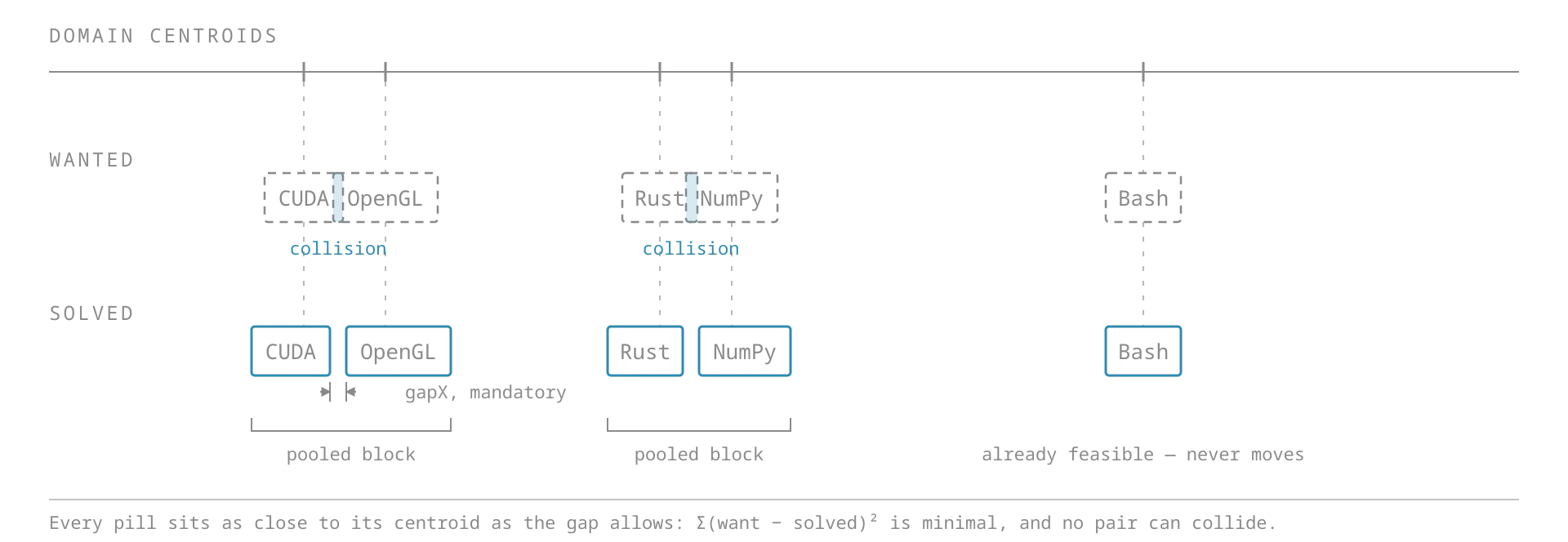 Pills want their domains’ centroid; the gap says they cannot all have it. The solver moves the least it can get away with.
The first version of this solver did what everyone’s first version does. Place everything at its target, look for overlaps, push the offenders apart, repeat until nothing moves or the iteration budget runs out. It mostly worked. It had a proximity threshold, a relaxation factor, and a maximum pass count, and each of the three was a number I had picked by looking at the result and changing it until the result looked better. Add a skill with a long name and one of them would need picking again.
Rewriting the constraint
Number the pills in a row left to right and let x_i be the centre of pill
i. The spacing rule is
x_{i+1} − x_i ≥ halfW_i + halfW_{i+1} + gapXThe right-hand side is fixed: it depends only on the two pills’ widths, and the
widths are known before anything is placed. So define c_i as the cumulative
minimum separation from the first pill — c_1 = 0, and each subsequent c
adds the pair’s required distance — and substitute x_i = u_i + c_i.
Every constant cancels, and the constraint collapses to
u_1 ≤ u_2 ≤ … ≤ u_nThe pills are gone. What is left is a list of numbers that has to come out non-decreasing, and a set of targets it should stay as close to as possible. That is isotonic regression, and isotonic regression under squared error is solved exactly by pool adjacent violators.
The corridor edges come along for free. Clamping the first pill’s left edge and
the last pill’s right edge both turn into bounds on u, and because the c
terms cancel there too, they are the same interval for every u_i. One
clamp at the top of the loop, and the row can no longer run off the sheet.
The pass
/** Place a row's pills at minimum total displacement from their    targets, subject to `gapX` between neighbours and the corridor. */function solveRow(items: Placed[]): void {  const n = items.length;
  // c_i — cumulative minimum separation from the first pill.  const c: number[] = [0];  for (let i = 1; i < n; i++) {    c.push(c[i - 1] + items[i - 1].halfW + items[i].halfW + LAYOUT.gapX);  }
  const lo = MIN_X + items[0].halfW;  const hi = MAX_X - items[n - 1].halfW - c[n - 1];
  // Blocks of pooled values, kept as (mean, size) pairs.  const val: number[] = [];  const size: number[] = [];  for (let i = 0; i < n; i++) {    val.push(clamp(items[i].target - c[i], lo, hi));    size.push(1);    while (val.length > 1 && val[val.length - 2] > val[val.length - 1]) {      const v2 = val.pop()!, n2 = size.pop()!;      const v1 = val.pop()!, n1 = size.pop()!;      val.push((v1 * n1 + v2 * n2) / (n1 + n2));      size.push(n1 + n2);    }  }
  let k = 0;  for (let b = 0; b < val.length; b++) {    for (let m = 0; m < size[b]; m++, k++) items[k].x = val[b] + c[k];  }}
Twenty-odd lines, one pass, and the inner while is amortised constant: every
iteration removes a block, and blocks are only ever created once each.
The pooling is the part worth watching. When two pills want to be in the wrong order, they are merged into a block that sits at their mean, and from then on they move together. A third pill can pull the whole block; the block never comes apart. That is why the figure above shows the pair moving as a unit rather than one of them budging and the other staying put — and it is also why the answer is optimal rather than merely tidy.
What about the rows themselves?
Rows never collide with each other for a duller reason: they sit one rowPitch
apart and a pill is PILL.height tall, with rowPitch larger than the height.
There is no interaction between rows to solve. A skill’s row comes from its
tier — how many domains it feeds — so a tool shared by three domains sinks
toward the ground line and a specialist rides the top.
What it bought
The tuning constants are gone. There is no relaxation factor, no proximity threshold, no iteration cap, and no “good enough” — the output is the exact minimiser of total squared displacement subject to the constraints, every time, for any set of skills that fits the corridor at all.
The build still asserts clearance, on the rounded numbers that actually ship rather than on the solver’s full-precision output — a check that passes at double precision and fails at two decimals is not a check. It runs on every build and exits non-zero. It has never fired. The point of keeping it is that if someone rewrites this solver into something with a tuning constant in it, they will find out on the first build rather than in a screenshot.
Comments